Sea Moss: Benefits, Side Effects and Dosage
Chondrus crispus
Also called: Irish moss, Irish sea moss, Chondrus crispus, Gracilaria sea moss
Last reviewed by the Ledger Research Desk· Published · 9 min read
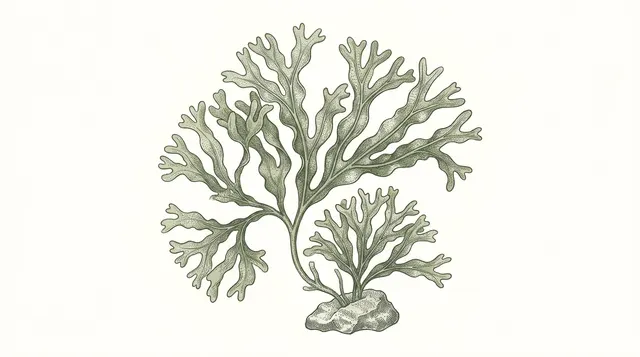
In short: Sea moss is red seaweed, mainly Chondrus crispus (Irish moss) and Gracilaria species, sold as gel, capsules, powder and gummies. We found no controlled human trial of sea moss itself, so we grade every outcome None: popular claims rest on lab, animal and general seaweed data. The practical issues are variable iodine content, possible heavy metals, and the difference between whole seaweed and carrageenan.
Quick facts
- Also known as
- Chondrus crispus · Irish moss · Irish sea moss · Chondrus crispus · Gracilaria sea moss
- Type
- Marine & Algae
- Source
- Red seaweed, mainly Chondrus crispus (Irish moss) and Gracilaria species, sold dried as gel, capsules, powder and gummies. Not the same as carrageenan, the purified food additive made from red seaweeds.
- Common forms
- Capsule or powder (ground dried seaweed)
- Gel (dried seaweed soaked and blended with water)
- Liquid glycerite extract
- Gummy (blend with other ingredients)
- Typical label dose
- Median 500 mg per serving (middle half of labels: 500–1,039 mg)
From 64 of 88 randomly sampled US product labels in the NIH Dietary Supplement Label Database, downloaded Nov 27, 2026. Not a recommended dose. How we counted - Evidence at a glance
- Who should avoid it
- People with thyroid disease or taking thyroid medicine (iodine load; a kelp case report described hyperthyroidism)[9]
- Pregnancy and breastfeeding (safety of sea moss not established; iodine needs differ)[7]
- Young children (4 g of dried Irish moss gave about a quarter of a child's recommended iodine intake)[3]
- Key interactions
- No drug interactions documented by the sources we checked. Details
- Regulatory status
- US: Sold as a dietary supplement and food; manufacturers are responsible for evaluating safety and labeling before marketing (as of Nov 28, 2026)[1]
- EU: Carrageenan (E 407) and processed Eucheuma seaweed (E 407a) re-evaluated as food additives; group ADI of 75 mg per kg body weight kept as temporary (applies to the additive, not whole sea moss supplements) (as of Nov 28, 2026)[2]
- Last reviewed
- · Editorial review by the Ledger Research Desk
On this page
What is sea moss?
"Sea moss" is a market name, not a single species. Labels in our sample mostly say Irish moss or Irish sea moss, and the species behind that name is Chondrus crispus, a red seaweed of North Atlantic coasts. Other red seaweeds, including Gracilaria species, are also sold as sea moss, so two products with the same name can be different organisms.
In the US, sea moss is sold as a dietary supplement and as a food. Manufacturers and distributors are responsible for evaluating the safety and labeling of their products before marketing [1]. People mostly look it up because of social-media claims about immunity, skin, thyroid and gut health.
It belongs to our marine and algae ingredients group; the A to Z index lists the rest of the library.
Sea moss forms and composition
| Form | Standardized to | Typical extract ratio | Source |
|---|---|---|---|
| Capsule or powder (ground dried seaweed) | Not established | Not established | — |
| Gel (dried seaweed soaked and blended with water) | Not established | Not established | — |
| Liquid glycerite extract | Not established | Not established | — |
| Gummy (blend with other ingredients) | Not established | Not established | — |
Whole sea moss is a dried or gelled seaweed, not a purified extract. Capsules and powders contain ground dried seaweed, the gel is the dried seaweed soaked and blended with water, and gummies mix it with other ingredients. Composition varies with species, harvest site and season, which matters most for minerals. An in vitro study of red seaweeds including C. crispus reported that 100 g supplied 28 to 107 percent of daily calcium needs, 183 to 600 percent of iron needs and 18 to 54 percent of zinc needs across the seaweeds tested, while copper and iodine were low [4]. Two further distinctions matter. First, whole seaweed is not carrageenan. Carrageenan is a gelling polysaccharide purified from red seaweeds and used as a food additive. EFSA's 2018 re-evaluation covered the purified additive (E 407) and processed Eucheuma seaweed (E 407a), found that carrageenan is not absorbed intact, and kept an acceptable daily intake of 75 mg per kilogram of body weight as a temporary value [2]. Safety data on the purified additive do not transfer to a whole-seaweed supplement, and findings on whole sea moss do not transfer to the additive. Second, kelp, dulse, nori and sea moss are different seaweeds with very different iodine contents.
What the research shows
We grade each outcome using the rules on our methodology page: Strong needs at least two agreeing randomized trials, Limited is one trial or several small, short or conflicting ones, and None means no controlled human trial. We searched PubMed for human studies of Chondrus, sea moss and Irish moss and found cell, animal, in vitro and composition studies, but no randomized trial of sea moss supplements. A 2019 review of edible seaweeds in general concluded that more evidence from human intervention studies is needed [7]. Where a headline claim cites "studies", the study is usually a lab experiment, an animal experiment or a trial of a different seaweed.
Gut health and digestion None
The nearest evidence is a laboratory model. In an in vitro digestion and fermentation experiment using human gut microbiota, whole red seaweeds including C. crispus were fermented, with increases in some bacterial groups such as Akkermansia muciniphila [4]. A separate in vitro experiment with stool microbiota from lean and obese adults reported that Irish moss was among the ingredients fermented at a high rate [5]. Neither study gave sea moss to people, and neither measured symptoms, stool habits or health outcomes.
Thyroid function and iodine status None
No controlled trial has given sea moss to people and measured thyroid tests. The evidence concerns iodine content (see side effects below), not a measured effect.
Fertility and sexual health None
The only study we found on this topic is in rats: 12 male albino rats in two groups of six, with C. crispus injected into muscle twice a week for 48 days. Sperm motility was higher and one oxidative marker lower, while testosterone rose non-significantly [6]. Injection in six animals says nothing about swallowing a capsule or gel as a person.
Immune function and colds None
We found no controlled human trial of sea moss on infections, immune markers or cold symptoms. Reports citing immune effects rely on laboratory work with isolated compounds.
Blood sugar and weight None
We found no controlled human trial of sea moss on glucose, insulin, body weight or appetite.
Sea moss dosage
What US labels list
Median 500 mg per serving across 64 labels that state an amount. The middle half of labels list 500–1,039 mg; the full range is 50–3,800 mg. 33% of sampled products contain Sea moss as the only active ingredient. 17.2% of the labels with an amount name a standardization or marker compound. This describes what products contain, not a recommended dose.
1 sampled labels did not list sea moss as a named ingredient row; 23 listed it without a usable amount per serving (for example inside a proprietary blend).
Seeded random sample of 88 on-market products from the NIH Dietary Supplement Label Database (search: "sea moss", 88 unique on-market products found), downloaded Nov 27, 2026. Not weighted by sales. Method
No trial dose exists, because there are no controlled human trials of sea moss supplements.
| Study | Population | Dose and form | Duration |
|---|---|---|---|
| No controlled human trial of sea moss found | None | None | None |
What labels list is a different question. Our sample is a seeded random draw of on-market products whose name or ingredient list names sea moss, taken from the first 600 hits of the NIH Dietary Supplement Label Database (DSLD) search for "sea moss", with duplicates by brand and product name removed; it is not weighted by sales. It contained 88 products, 87 of which list sea moss as an ingredient. Of those, 64 gave a usable amount in milligrams: the median was 500 mg per serving, the middle half ran from 500 to 1,039 mg, and the range was 50 to 3,800 mg (methodology). Twenty-three labels named sea moss without an amount, usually inside a blend. Among the 23 single-ingredient products the median was 1,000 mg, with a middle half of 500 to 1,178 mg.
A label amount is a weight of seaweed and says nothing about its iodine or metal content. These figures describe what is sold and are never a recommendation. The only upper limit we found that applies to a nutrient in sea moss is the adult tolerable upper intake level for iodine of 1,100 mcg per day, quoted in a risk assessment of red seaweeds [3]. We do not offer a dose of our own.
Sea moss side effects and who should avoid it
No trial reports side-effect rates for sea moss, so frequency is unknown. Risks come from what seaweed contains.
Iodine. A 2020 analysis of 30 samples of dulse and Irish moss found the highest average iodine in Irish moss, 3.86 mg per kilogram dry weight (standard deviation 1.49). At that concentration the authors calculated that 4 g per day gave 25.7 percent of a child's recommended intake, and that about 286 g per day of dried Irish moss would reach the adult limit of 1,100 mcg [3]. By contrast, an analysis of 100 commercial seaweed products found that weekly kombu raised iodine intake by 400 to 800 percent, and the authors advised limiting kombu and wakame [8]. The spread around the sea moss mean, and the fact that Gracilaria and gel products were not in that analysis, mean you cannot assume a given product is low in iodine.
Thyroid. Excess iodine is the thyroid concern with seaweed. A published case report describes a 70-year-old woman who developed hyperthyroidism about 3 months after starting kelp-containing tablets, with thyroid function back to normal after 3 months without kelp [9]. That was kelp, not sea moss, but it shows why people with thyroid disease, or taking thyroid medicine, should ask a clinician before using any seaweed product.
Arsenic and other metals. A narrative review of edible seaweeds names excess iodine and arsenic as the main adverse-effect concerns [7]. The 100-sample commercial analysis found concentrations varied widely and estimated negligible risk from toxic elements for chronic exposure, but it tested kombu, wakame and nori, not sea moss [8]. We found no source measuring metals in sea moss gels or capsules, so we cannot state a typical level.
Points to raise with a clinician:
- Thyroid disease or thyroid medicine. Iodine load is the reason [9].
- Pregnancy and breastfeeding. We found no controlled data on sea moss, and iodine needs and limits differ in these periods. Safety is not established.
- Children. In the iodine analysis a 4 g serving of Irish moss already gave about a quarter of a child's recommended intake [3].
Sea moss interactions
None of the sources we checked document a drug interaction for Sea moss. That is not proof that none exists; ask a pharmacist about your own medicines.
No drug or nutrient interactions with sea moss are documented in the sources we reviewed. That is not proof that none exist. The practical interaction question is iodine: a clinician or pharmacist who knows your thyroid status can say whether added iodine from seaweed matters.
How to read a sea moss label
Start with the plant name and the amount. In our sample, many labels read like "Irish Moss 500 mg" or "organic Irish Sea Moss powder 8 g", which tells you the weight of dried seaweed. One liquid label listed an Irish moss glycerite extract at 1:5 with 0.13 mL per 25 drops, and another listed drops with no amount. A 2-capsule serving listing 500 mg means each capsule holds 250 mg, while a 1-capsule serving of 500 mg holds twice that per capsule.
What to check:
- Species. Look for Chondrus crispus or Irish moss versus a generic "sea moss" or "seaweed blend"; species changes the iodine profile.
- Whole seaweed or extract. Only 17.2 percent of sampled labels stated any standardization. A "1:5" extract is a different product from 500 mg of ground seaweed.
- Blends. Twenty-three labels named sea moss with no usable amount, often inside a proprietary blend, so you cannot tell how much seaweed you get. About a third of the products were single-ingredient.
To compare two products, convert both to milligrams of dried sea moss per day at the serving you would actually take, and note other ingredients. For how we write up outcomes that do have trials, see our pages on astaxanthin and lion's mane.
Bottom line
We see a popular seaweed with plenty of marketing and almost no human trial data: every outcome we reviewed is graded None, which means insufficient evidence, not proof of no effect. The reasons for care are concrete. Iodine content varies by species and product, a reported case of hyperthyroidism followed kelp tablets, and nobody has published metal levels for typical sea moss gels. We would want to see randomized trials of a defined sea moss product, with iodine and metals measured, before grading any outcome higher. Whole sea moss should not be confused with carrageenan, which EFSA evaluated as a purified additive. Questions about your thyroid or medicines belong with your clinician or pharmacist; our Research Desk page explains how we choose and grade studies.
Sources
- Dietary Supplements. U.S. Food and Drug Administration, 2026. Accessed .
- Re-evaluation of carrageenan (E 407) and processed Eucheuma seaweed (E 407a) as food additives. EFSA Panel on Food Additives and Flavourings (FAF), 2018. Accessed .
- Risk assessment of iodine intake from the consumption of red seaweeds (Palmaria palmata and Chondrus crispus). Environmental Science and Pollution Research, 2020. Accessed .
- Modulatory effects of red seaweeds (Palmaria palmata, Porphyra umbilicalis and Chondrus crispus) on the human gut microbiota via an in vitro model. Food Chemistry, 2025. Accessed .
- In vitro fermentability of a broad range of natural ingredients by fecal microbiota from lean and obese individuals: potential health benefits. International Journal of Food Sciences and Nutrition, 2022. Accessed .
- The effect of Red Seaweed (Chondrus crispus) on the fertility of male albino rats. Saudi Journal of Biological Sciences, 2021. Accessed .
- Risks and benefits of consuming edible seaweeds. Nutrition Reviews, 2019. Accessed .
- Dietary Risk Assessment and Classification Model Based on Trace Elemental Analysis in Commercially Available Dried Seaweed Products. Journal of Food Protection, 2025. Accessed .
- Transient Hyperthyroidism following the ingestion of complementary medications containing kelp seaweed: A case-report. Medicine (Baltimore), 2019. Accessed .
Frequently asked questions
What does sea moss do, according to trials?
We found no controlled human trial of sea moss itself, so we grade every outcome None. Laboratory fermentation studies and one small rat study exist, but they did not measure health outcomes in people.
How much iodine is in sea moss?
One analysis of 30 red seaweed samples found an average of 3.86 mg iodine per kilogram dry weight for Irish moss, much lower than kelp. Individual products vary, and the adult upper limit is 1,100 mcg per day [3].
Is sea moss the same as carrageenan?
No. Carrageenan is a gelling agent purified from red seaweeds, and EFSA's 2018 re-evaluation assessed that additive, not whole seaweed [2].
How much sea moss is on supplement labels?
In our sample of 64 US labels with a stated amount, the median was 500 mg per serving, with the middle half between 500 and 1,039 mg. Single-ingredient products had a median of 1,000 mg.
Who should check with a clinician first?
People with thyroid disease or thyroid medicine, anyone pregnant or breastfeeding, and parents of young children should ask first, because iodine intake matters in these groups and safety data for sea moss are lacking.
Related ingredients
More Marine & Algae →



Educational information only. Not medical advice. Talk to a clinician or pharmacist before starting a supplement, especially if you are pregnant, take medicines or have a health condition. Spotted an error? Tell us.