Lion's Mane: Benefits, Side Effects and Dosage
Hericium erinaceus
Also called: yamabushitake, hedgehog mushroom, Hericium erinaceus extract, monkey head mushroom
Last reviewed by the Ledger Research Desk· Published · 9 min read
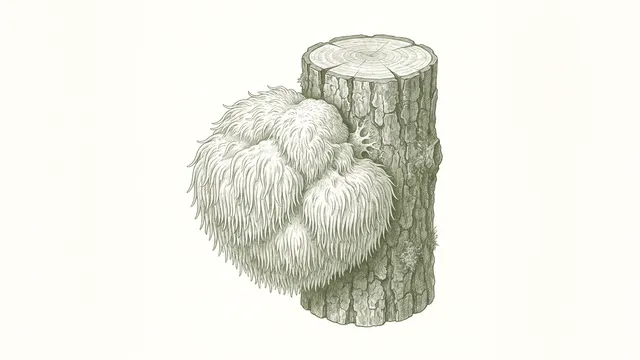
In short: Lion's mane (Hericium erinaceus) is an edible mushroom sold as capsules, powders and extracts. Human evidence is thin: each outcome rests on small trials of roughly 30 to 80 people lasting 4 to 52 weeks, so every outcome below is graded Limited or None. Its best-studied area is cognitive test scores in older adults, graded Limited. Reported side effects are mostly mild stomach complaints; one serious allergic-type lung reaction has been reported.
Quick facts
- Also known as
- Hericium erinaceus · yamabushitake · hedgehog mushroom · Hericium erinaceus extract · monkey head mushroom
- Type
- Mushrooms
- Source
- The shaggy white fruiting body of the edible mushroom Hericium erinaceus, or mycelium grown in culture; sold in the US as capsules, powders and extracts.
- Common forms
- Typical label dose
- Median 500 mg per serving (middle half of labels: 262–529 mg)
From 64 of 120 randomly sampled US product labels in the NIH Dietary Supplement Label Database, downloaded Nov 27, 2026. Not a recommended dose. How we counted - Evidence at a glance
- Who should avoid it
- Key interactions
- No drug interactions documented by the sources we checked. Details
- Regulatory status
- US: Sold as a dietary supplement; manufacturers are responsible for evaluating safety and labeling before marketing, and FDA does not approve supplements before sale (as of Nov 28, 2026)[1]
- Last reviewed
- · Editorial review by the Ledger Research Desk
On this page
What is lion's mane?
Lion's mane, also called yamabushitake or hedgehog mushroom, is the fruiting body of Hericium erinaceus, a white, shaggy mushroom that grows on hardwood. It is eaten fresh in cooking and is also dried, powdered and extracted for supplements. In the US it is sold as a dietary supplement, so FDA does not approve it before sale; manufacturers are responsible for evaluating safety and labeling before marketing [1].
People search for it mainly for memory, focus and mood. Because those are the topics the research has examined, this page reports what each named trial measured rather than what a product might do. For other fungi in the library, see mushroom ingredients or the A to Z index.
Lion's mane forms and composition
| Form | Standardized to | Typical extract ratio | Source |
|---|---|---|---|
| Fruiting-body powder or extract | hericenones are found only in fruiting bodies; products often state beta-glucan percentage | Not established | [10] |
| Erinacine A-enriched mycelia (culture) | erinacine A, 5 mg per gram (trial material) | Not established | [6] |
| Mycelium on grain (whole block ground) | Not established | Not established | — |
The label word "lion's mane" covers three different raw materials, and trial results do not transfer between them.
Fruiting body. This is the mushroom itself, dried and ground, or extracted with hot water or alcohol. A 2025 systematic review of preclinical studies states that hericenones are found only in fruiting bodies [10]. Three Japanese trials used fruiting-body powder in tablets or cookies [2] [4] [3].
Mycelium. Mycelium is the root-like network that grows through a substrate. The same review describes erinacines, a different compound class, as the main compounds in mycelia [10]. A Taiwanese trial used mycelia grown to be rich in erinacine A, at 5 mg per gram of capsule material [6].
Mycelium on grain. Many retail products grow mycelium on rice or oats and grind the whole block, so the powder includes the grain. Label wording such as "fermented brown rice biomass" in our sample marks this type. We found no trial that tested a product of that kind on its own.
Fruiting body products and mycelium-on-grain products are different materials with different marker compounds, so a result from one should not be read as a result for the other.
Extract ratios and standardization. A "8:1" ratio means 8 units of fresh or dry material were used for 1 unit of extract. A "std. to 45% beta-glucans" statement describes a lab assay of the powder, not a dose of any studied compound. Among the labels in our sample, about 34% carried some standardization statement. We did not find a trial that selected products by beta-glucan percentage, so a higher percentage on a label tells you about composition, not about a tested effect.
The figure below shows the product forms in our sample.
What the research shows
We grade each outcome separately using the rules on our methodology page. Grades are Strong, Limited or None. The trials are small, short and mostly from Japan, Taiwan and Italy, and several used different products. A 2025 systematic review found five randomized trials and three pilot trials in total [9].
Cognition in older adults with mild impairment Limited
In a 16-week double-blind trial of 30 Japanese adults aged 50 to 80 with mild cognitive impairment, the lion's mane group took four 250 mg tablets (96% dry fruiting-body powder) three times a day, about 3 g daily. Cognitive scale scores were higher than placebo at weeks 8, 12 and 16, and scores fell after the supplement was stopped [2]. A 12-week trial of fruiting-body supplements in about 31 healthy adults reported a difference on the Mini-Mental State Examination, though the groups started near the top of that scale [3] [9]. Both trials are small, and neither published abstract names a funder. Graded Limited.
Early Alzheimer's disease Limited
A pilot double-blind trial in Taiwan randomized 41 people with early Alzheimer's disease to capsules of erinacine A-enriched mycelia or placebo for 49 weeks. The mycelia group scored better on several cognitive and daily-function measures while the placebo group declined on some; four participants left the trial because of adverse effects [6]. This is one small pilot of a mycelium product, not a fruiting-body supplement. Graded Limited.
Cognition in healthy young adults Limited
In a 41-person pilot trial of healthy adults aged 18 to 45, a single 1.8 g dose was followed by faster Stroop task responses at 60 minutes. After 28 days of 1.8 g daily, subjective stress showed a trend toward lower scores, and the authors noted small samples and null results. The study was funded by Sempera Organics, a company that sells lion's mane [7]. A separate crossover trial tested a single 1 g dose of a Nordic lion's mane extract against placebo and reported higher working memory, attention and reaction-time scores two hours later [8]. Single-dose results do not show what happens with ongoing use. Graded Limited.
Mood, stress and anxiety Limited
A trial of 30 women eating lion's mane cookies or placebo cookies for 4 weeks reported lower depression and anxiety scores in the lion's mane group [4]. An Italian trial of 77 people with overweight or obesity and a mood or sleep disorder, on a low-calorie diet, reported lower depression, anxiety and sleep-disorder scores after 8 weeks plus a higher pro-BDNF level [5]. Participants were not blinded to diet, the product was a mycelium-and-extract mix, and the 28-day Docherty trial found only a trend. Graded Limited.
Nerve growth and brain-cell claims None
Many pages say lion's mane raises nerve growth factor (NGF). The evidence is cell and animal work: erinacines and hericenones stimulate NGF synthesis in glial cells in vitro, and erinacine A-rich mycelia raised hippocampal NGF in animals [10]. We found no controlled human trial measuring NGF in the brain. Graded None; the evidence is insufficient, not negative.
Cancer and immune claims None
The 2025 systematic review lists anticancer activity only among its laboratory studies, and none of its human trials measured cancer outcomes [9]. Graded None.
Lion's mane dosage
What US labels list
Median 500 mg per serving across 64 labels that state an amount. The middle half of labels list 262–529 mg; the full range is 25–2,400 mg. 16.7% of sampled products contain Lion's Mane as the only active ingredient. 34.4% of the labels with an amount name a standardization or marker compound. This describes what products contain, not a recommended dose.
0 sampled labels did not list lions mane as a named ingredient row; 56 listed it without a usable amount per serving (for example inside a proprietary blend).
Seeded random sample of 120 on-market products from the NIH Dietary Supplement Label Database (search: "lion's mane", 285 unique on-market products found), downloaded Nov 27, 2026. Not weighted by sales. Method
Trials gave a lot more mushroom material than most labels list per serving. No official recommended or upper intake exists for lion's mane, and we do not offer one.
| Study | Population | Dose and form | Duration |
|---|---|---|---|
| Mori 2009 | 30 adults with mild cognitive impairment | 3 g/day, 96% fruiting-body powder tablets | 16 weeks |
| Nagano 2010 | 30 women | 2 g/day powdered fruiting body in cookies | 4 weeks |
| Vigna 2019 | 77 adults, overweight or obesity | Mycelium plus fruiting-body extract capsules | 8 weeks |
| Li 2020 | 41 adults with early Alzheimer's disease | About 1,050 mg/day erinacine A-enriched mycelia | 49 weeks |
| Docherty 2023 | 41 healthy adults | 1.8 g/day (single 1.8 g dose first) | 28 days |
| La Monica 2023 | Healthy adults, crossover | 1 g single dose, Nordic lion's mane extract | One day |
Sources for the table are in the research section above. In our sample of 120 US labels, 64 stated a numeric amount per serving. The median was 500 mg (middle half 262 to 529 mg). Among the 19 products where lion's mane is the only active ingredient, the median was 650 mg (middle half 500 to 1,000 mg). Details are on our label-data method.
Two cautions apply. A label milligram figure for an 8:1 extract is not the same as 500 mg of powder, and 56 of the 120 labels listed lion's mane with no usable amount, often inside a proprietary blend. We do not present any label dose as a recommendation.
Lion's mane side effects and who should avoid it
In the trials, side effects were mild and not clearly different from placebo. In the Mori trial, mild stomach discomfort and diarrhea were reported by 7 people on lion's mane and 6 on placebo [9]. In the 49-week Taiwanese trial, abdominal discomfort, nausea and skin rash were reported, and four participants left because of adverse effects [6]. The systematic review lists stomach discomfort, headache and allergic reactions, noting they are rarely reported [9].
A serious reaction has been described once. A 63-year-old man developed acute respiratory distress syndrome with diffuse lung infiltration after taking an extract for about four months; a lymphocyte stimulation test reacted to the extract, and he recovered with steroid pulse therapy under mechanical ventilation. The authors called it the first report suggesting a causal link [11]. It is a single case.
People who have had a breathing or allergic reaction to a mushroom product are the group most worth raising with a clinician before taking lion's mane. None of the human trials listed in the 2025 review enrolled pregnant or breastfeeding women or children [9], so safety in those groups has not been tested. Anyone planning surgery or taking prescription medicines can ask a pharmacist whether a mushroom supplement is a concern for them.
Lion's mane interactions
None of the sources we checked document a drug interaction for Lion's Mane. That is not proof that none exists; ask a pharmacist about your own medicines.
We found no documented drug, herb or supplement interactions for lion's mane in the human studies and reviews we read. The absence of reports is not proof of safety: the trials were small. The studies do not examine blood thinners, diabetes medicines or immune-suppressing drugs, so a pharmacist is the right person to ask about those. We do not list theoretical interactions without a source.
How to read a lion's mane label
Start with the ingredient row. These examples come from our sample, without brand names.
- "Lion's Mane Mushroom Fruiting Body Extract, 250 mg, 1:1, at least 20% beta-(1,3)(1,6) D-glucans" names the plant part, the ratio and a beta-glucan assay.
- "Lion's Mane Fruiting Body Extract, 200 mg, 8:1, equivalent to 1,600 mg lion's mane" states the extract amount and the starting material; 200 mg of extract is not 1,600 mg of the extract.
- "Lion's Mane, 200 mg" with a note "fermented brown rice biomass" signals mycelium on grain.
- "Lion's Mane" with no amount, or listed inside a blend, gives no per-serving dose.
Check four things. First, the plant part: fruiting body, mycelium, or both. Second, the serving size: one powder serving can weigh 4.6 to 14 g, while the lion's mane row may be only 500 mg of it. Third, whether the amount is extract or raw powder. Fourth, whether it is a proprietary blend, which hides the amount. To compare two products, convert each to mg of the named ingredient per day and note the plant part; compare "8:1" extracts to powders only if both state the equivalent. More on how we handle label data is at the Research Desk.
Bottom line
We would treat lion's mane as an under-studied ingredient. The best human data are a handful of small trials, graded Limited, in older adults, early Alzheimer's disease, young adults and mood, and one of them was funded by a company that sells lion's mane. We would want to see larger randomized trials of a single, well-described product, ideally fruiting body and mycelium compared directly, before placing it higher. The nerve-growth and cancer claims have no controlled human trial behind them. Labels are inconsistent: half of sampled labels state no usable amount, and trial doses were far above the typical per-serving figure. Anyone with a mushroom allergy or a history of reactions to supplements can take the label, not marketing copy, to a clinician or pharmacist.
Sources
- Dietary Supplements. FDA, 2026. Accessed .
- Improving effects of the mushroom Yamabushitake (Hericium erinaceus) on mild cognitive impairment: a double-blind placebo-controlled clinical trial. Mori K, et al, 2009. Accessed .
- Improvement of cognitive functions by oral intake of Hericium erinaceus. Saitsu Y, et al, 2019. Accessed .
- Reduction of depression and anxiety by 4 weeks Hericium erinaceus intake. Nagano M, et al, 2010. Accessed .
- Hericium erinaceus Improves Mood and Sleep Disorders in Patients Affected by Overweight or Obesity: Could Circulating Pro-BDNF and BDNF Be Potential Biomarkers?. Vigna L, et al, 2019. Accessed .
- Prevention of Early Alzheimer's Disease by Erinacine A-Enriched Hericium erinaceus Mycelia Pilot Double-Blind Placebo-Controlled Study. Li IC, et al, 2020. Accessed .
- The Acute and Chronic Effects of Lion's Mane Mushroom Supplementation on Cognitive Function, Stress and Mood in Young Adults: A Double-Blind, Parallel Groups, Pilot Study. Docherty S, et al, 2023. Accessed .
- Acute Effects of Naturally Occurring Guayusa Tea and Nordic Lion's Mane Extracts on Cognitive Performance. La Monica MB, et al, 2023. Accessed .
- Benefits, side effects, and uses of Hericium erinaceus as a supplement: a systematic review. Menon A, et al, 2025. Accessed .
- Unveiling the role of erinacines in the neuroprotective effects of Hericium erinaceus: a systematic review in preclinical models. Spangenberg ET, et al, 2025. Accessed .
- Hericium erinaceum (yamabushitake) extract-induced acute respiratory distress syndrome monitored by serum surfactant proteins. Nakatsugawa M, et al, 2003. Accessed .
Frequently asked questions
What are the benefits of lion's mane?
Small human trials have measured cognitive test scores and mood scores, and results were mixed. In a 16-week trial of 30 adults with mild cognitive impairment, scores were higher than placebo, but trials in healthy adults had mostly null or trend-level results. We grade every outcome Limited or None.
What are lion's mane side effects?
Reported side effects were mild: stomach discomfort, nausea, headache, diarrhea and skin rash. One case report describes acute respiratory distress syndrome after months of extract use, which the authors linked to an allergic-type reaction.
How much lion's mane is on a typical US label?
Among 64 sampled labels that state an amount, the median is 500 mg per serving, with the middle half between 262 and 529 mg. Products where lion's mane is the only active ingredient have a median of 650 mg. Amounts may be extract or raw powder, so they are not always comparable.
Is fruiting body or mycelium better?
We cannot rank them. Hericenones are found only in fruiting bodies and erinacines mainly in mycelia, and the trials used different products. No trial compared the two directly.
Is lion's mane the same as other medicinal mushrooms?
No. Each mushroom has its own compounds and trial record. Browse the mushrooms section for the others.
Related ingredients
More Mushrooms →
Educational information only. Not medical advice. Talk to a clinician or pharmacist before starting a supplement, especially if you are pregnant, take medicines or have a health condition. Spotted an error? Tell us.