Astaxanthin: Benefits, Side Effects and Dosage
Also called: Haematococcus pluvialis extract, natural astaxanthin, algal astaxanthin
Last reviewed by the Ledger Research Desk· Published · 9 min read
In short: Astaxanthin is a red carotenoid pigment, sold mostly as softgels made from the microalga Haematococcus pluvialis. Its best-studied area is skin, where a few small trials at 4 to 6 mg daily measured wrinkle, moisture and UV-response scores; we grade that Limited. Every other outcome we reviewed is also Limited. EFSA judged 8 mg per day from supplements safe for adults.
Quick facts
- Also known as
- Haematococcus pluvialis extract · natural astaxanthin · algal astaxanthin
- Type
- Marine & Algae
- Source
- A red carotenoid pigment; supplements mostly use astaxanthin extracted from the freshwater microalga Haematococcus pluvialis, sold as softgels or capsules in oil. Synthetic astaxanthin also exists.
- Common forms
- Typical label dose
- Median 2 mg per serving (middle half of labels: 0.24–5 mg)
From 112 of 120 randomly sampled US product labels in the NIH Dietary Supplement Label Database, downloaded Nov 27, 2026. Not a recommended dose. How we counted - Evidence at a glance
- Who should avoid it
- Children and adolescents (EFSA estimated intake at or above its reference value; safety conclusion covers adults only)[1]
- Pregnancy and breastfeeding (safety not established; not addressed by EFSA)[1]
- People with liver conditions (EFSA's reference value rests on a liver finding in rats; ask a clinician)[1]
- People with seafood allergy (hypersensitivity-type reactions noted by meta-analysis authors)[11]
- Key interactions
- No drug interactions documented by the sources we checked. Details
- Regulatory status
- US: Sold as a dietary supplement; FDA closed GRAS notice GRN 294 for Haematococcus pluvialis extract (0.1 mg astaxanthin per serving in foods) with no questions, some uses may need a color additive listing (as of Nov 28, 2026)[2]
- EU: EFSA 2020 opinion: 8 mg per day from food supplements, with dietary intake, safe for adults; children's estimated exposure exceeds the reference value (as of Nov 28, 2026)[1]
- Last reviewed
- · Editorial review by the Ledger Research Desk
On this page
What is astaxanthin?
Astaxanthin is a red-orange carotenoid, the pigment that colors salmon, shrimp and krill. Supplements use it from several origins. The most common in US labels is Haematococcus pluvialis, a freshwater microalga; synthetic astaxanthin and astaxanthin from other microbes also exist. EFSA applied one reference value to both algal and synthetic astaxanthin [1].
In the US, astaxanthin is sold as a dietary supplement, usually in softgels. FDA has also issued "no questions" letters for food-ingredient notices on H. pluvialis extract containing astaxanthin esters, for example GRN 294, filed in 2009 for use at 0.1 mg of astaxanthin per serving [2].
It belongs to our marine and algae ingredients group; the A to Z index lists the rest of the library.
Astaxanthin forms and composition
| Form | Standardized to | Typical extract ratio | Source |
|---|---|---|---|
| Softgel or capsule (Haematococcus pluvialis extract in oil) | astaxanthin, mg per serving | Not established | [1] |
| Algal extract or oleoresin listed by weight | percent astaxanthin of the extract weight | Not established | [2] |
| Synthetic astaxanthin | Not established | Not established | — |
Astaxanthin is fat-soluble, so most products suspend it in oil inside a softgel or capsule. Most labels list astaxanthin itself in milligrams, but some list an algal extract by weight, of which astaxanthin is a small percentage. Compare the astaxanthin number, not the extract weight.
Source matters. Natural astaxanthin from H. pluvialis and synthetic astaxanthin are chemically different products. A 2019 safety review argued that safety data from synthetic astaxanthin should not be used to judge the natural form [3], whereas EFSA applied one reference value to both [1]. Most trials below used H. pluvialis astaxanthin, and several were sponsored by, or had authors employed by, the maker of the ingredient tested. Results for one branded ingredient are not automatically transferable to every product.
What the research shows
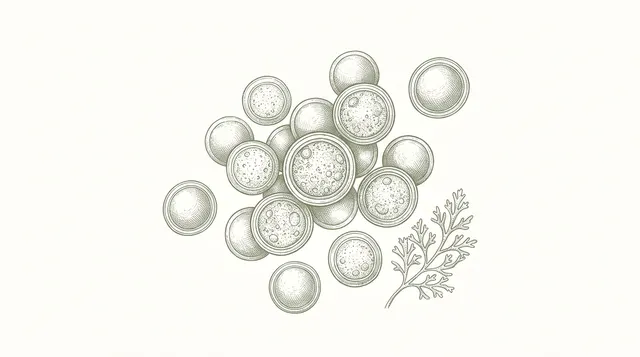
We grade each outcome using the rules on our methodology page: Strong needs at least two agreeing randomized trials, Limited is one trial or several small, short or conflicting ones, and None means no controlled human trial. The sketch below shows how small the trials we cite were.
Skin wrinkles, moisture and UV response Limited
In a double-blind trial of 36 healthy men taking 6 mg per day of H. pluvialis astaxanthin for 6 weeks, crow's-feet wrinkle scores, elasticity and transepidermal water loss were rated better than with placebo, while cheek moisture and sebum only trended that way [4]. The paper's other study, of 30 women, had no placebo group.
A second trial gave 4 mg per day for 9 weeks to 23 healthy adults aged 30 to 56, most of them women. The astaxanthin group showed a larger rise in the UV dose needed to redden skin, and a smaller UV-related moisture drop at one test dose but not another; objective wrinkle depth was not measured [5]. Its authors work for the company that sponsored the study and makes the ingredient. Both skin trials are small and short, so we grade this outcome Limited.
Eye fatigue and visual function Limited
In a 6-week trial of 60 adults who work at screens and report frequent eye fatigue, 9 mg per day of Haematococcus astaxanthin did not change the primary outcome, visual acuity, across the whole group. Among the 22 participants aged 40 and over, post-screen-work acuity in the dominant eye was better than with placebo, but this was a post hoc subgroup without adjustment for multiple comparisons [6]. The sponsor and several authors are tied to the product's maker. One trial with a null primary result and an unplanned subgroup finding is Limited evidence.
Exercise performance and endurance Limited
The trials disagree. In 32 trained male cyclists and triathletes, 20 mg per day for 4 weeks changed neither fat use nor time-trial results [7]. In 37 analyzed teenage taekwondo athletes, 12 mg per day for 4 weeks was followed by higher kick counts than placebo in two timed tests [8]. A crossover study of 10 active young men gave 28 mg per day for 4 days and recorded a longer time to exhaustion at 75 percent of maximal oxygen uptake [9]. Different sports, doses and designs make this Limited.
Cognitive function Limited
One pilot trial of 21 adults with mild cognitive impairment gave 6 mg of astaxanthin plus 10 mg of sesamin daily for 12 weeks. Raw test scores did not differ between groups, though change from baseline in psychomotor and processing speed was larger in the astaxanthin group, and only 14 people were analyzed [10]. Astaxanthin was combined with sesamin and the authors work for the ingredient's maker, so effects cannot be assigned to astaxanthin alone. Limited.
Blood lipids, blood glucose and blood pressure Limited
A 2015 meta-analysis of 7 randomized trials (280 participants, 4 to 20 mg per day, 4 weeks to 3 months) found no significant change in total cholesterol, LDL-C, HDL-C or triglycerides, and a small, non-significant change in glucose [11]. A 2020 meta-analysis of 14 articles reported higher HDL-C, with no association for LDL-C, triglycerides, fasting glucose, HbA1c or blood pressure; C-reactive protein was lower only with at least 12 weeks and more than 12 mg per day [12]. Mostly null, with one conditional finding in small trials: Limited.
Astaxanthin dosage
What US labels list
Median 2 mg per serving across 112 labels that state an amount. The middle half of labels list 0.24–5 mg; the full range is 0–100 mg. 24.2% of sampled products contain Astaxanthin as the only active ingredient. 3.6% of the labels with an amount name a standardization or marker compound. This describes what products contain, not a recommended dose.
1 sampled labels did not list astaxanthin as a named ingredient row; 7 listed it without a usable amount per serving (for example inside a proprietary blend).
Seeded random sample of 120 on-market products from the NIH Dietary Supplement Label Database (search: "astaxanthin", 422 unique on-market products found), downloaded Nov 27, 2026. Not weighted by sales. Method
The trials in this page used the following amounts.
| Study | Population | Dose and form | Duration |
|---|---|---|---|
| Ito 2018, skin | 23 healthy adults | 4 mg/day, H. pluvialis capsule | 9 weeks |
| Tominaga 2012, skin | 36 healthy men | 6 mg/day, H. pluvialis | 6 weeks |
| Spiller 2003, safety | 35 healthy adults | 6 mg/day, algal extract gelcaps | 8 weeks |
| Ito 2018, cognition | 21 adults with MCI | 6 mg/day with 10 mg sesamin | 12 weeks |
| Sekikawa 2023, eyes | 60 adults, screen workers | 9 mg/day, Haematococcus soft capsule | 6 weeks |
| Zhang 2025, athletes | 42 male teenage athletes | 12 mg/day, natural astaxanthin capsule | 4 weeks |
| Res 2013, cyclists | 32 trained men | 20 mg/day | 4 weeks |
| Tsao 2025, cycling | 10 active young men | 28 mg/day, capsules | 4 days |
Sources are the trial reports cited in the previous section, plus Spiller [13].
Our own label sample is more modest than most trials. In our sample of 120 US astaxanthin labels, 112 stated an amount per serving; the median was 2 mg, and the middle half ran from 0.24 to 5 mg (methodology). Many are multi-ingredient products with small amounts. Among the 29 single-ingredient products the median was 8 mg, with a middle half of 4 to 12 mg. The highest amount in the sample was 100 mg. These figures describe what is sold and are never a recommendation.
Official figures: EFSA's panel assessed 8 mg per day from food supplements on top of dietary intake and judged the combined exposure safe for adults [1]. Its reference value (an acceptable daily intake of 0.2 mg per kilogram of body weight) came from a liver finding in rats. Recommended or approved doses varied by country, from 2 to 24 mg [3]. We do not offer a dose of our own.
Astaxanthin side effects and who should avoid it
Most human trials report no serious problems. In an 8-week randomized trial of 35 healthy adults taking 6 mg per day, blood pressure and blood chemistry were checked at baseline, week 4 and week 8; only serum calcium, total protein and eosinophils differed, and the authors called the differences very small and not clinically important [13]. The 2018 skin trial saw no capsule-related events [5], and in the cognition pilot events occurred in both groups at similar rates [10]. The eye-fatigue trial found some laboratory differences that stayed within normal ranges [6]. The 12 mg taekwondo trial reported no adverse events [8].
A 2019 review of 87 human studies of natural astaxanthin, 35 of them at 12 mg per day or more, found no safety concerns [3]. Reported side effects in trials are rare, but trials were small and short, and no pooled frequency has been published in the sources we reviewed. We found no source quantifying skin color change, and we do not state one.
Points to raise with a clinician:
- Liver. EFSA's reference value rests on multinucleated liver cells in a 2-year rat study, which the panel considered adverse [1]. People with liver conditions may want to ask before using it.
- Children and teenagers. EFSA estimated that adolescents aged 14 to under 18 reach the reference value under the 8 mg scenario, and children aged 10 to under 14 exceed it by 28 percent [1]. The taekwondo trial enrolled 15 to 18 year olds, yet the opinion's safety conclusion covers adults only.
- Seafood allergy. The authors of the 2015 meta-analysis noted that people with seafood allergies may experience hypersensitivity-type reactions [11].
- Pregnancy and breastfeeding. We found no controlled trial data, and the EFSA opinion does not address these groups. Safety is not established.
- Surgery. No source we reviewed gives surgery-specific guidance; ask a surgeon or pharmacist before a procedure.
Astaxanthin interactions
None of the sources we checked document a drug interaction for Astaxanthin. That is not proof that none exists; ask a pharmacist about your own medicines.
No drug or nutrient interactions are documented in the sources we reviewed. EFSA's 2020 opinion does not discuss them, and the abstract of the 2019 safety review does not list any [1] [3]. Trial participants were mostly healthy. Absence of a documented interaction is not evidence that none exists. Questions to bring to a pharmacist: does the product contain other ingredients, such as sesamin or other carotenoids, and does it fit with every medicine you take?
How to read an astaxanthin label
Start with the unit and the serving. A softgel listing "Astaxanthin 280 mcg" holds 0.28 mg, while another listing "Astaxanthin 12 mg" holds about 43 times as much; a 2-softgel serving listing 300 mcg means each softgel has half that.
What to check:
- Astaxanthin versus extract. One sampled capsule listed 2 mg per 2 capsules of an algal "natural astaxanthin complex" standardized to 2 percent, alongside other carotenoids such as lutein, canthaxanthin and beta-carotene. A line like that is a blend, and only part of it is astaxanthin.
- Branded ingredient names. Some labels list a trademarked ingredient name (one showed 6 mg and another 12 mg under such a name) instead of the word astaxanthin. Look for Haematococcus pluvialis or "natural" versus synthetic.
- No amount. Of 120 sampled labels, 7 named astaxanthin without a usable amount, often inside a proprietary blend, and one listed no named row. Only 3.6 percent stated a standardization.
To compare two products, convert both to milligrams of astaxanthin per day at the serving you would actually take, and check whether other active ingredients are present.
Bottom line
We see a compound with small, short trials and consistently Limited grades. Skin has the most trial data, yet two small studies are not enough to call it Strong, and several trials were run by the makers of the ingredient. Side effects look uncommon in healthy adults over weeks to months, and EFSA judged 8 mg per day from supplements safe for adults, but data on pregnancy, children and long-term use are thin. We would want to see larger, independently funded trials with objective measures before grading any outcome higher. Questions about your medicines belong with your clinician or pharmacist; our Research Desk page explains how we choose and grade studies.
Sources
- Safety of astaxanthin for its use as a novel food in food supplements. EFSA Panel on Nutrition, Novel Foods and Food Allergens (NDA), 2020. Accessed .
- GRN No. 294 - GRAS Notices. U.S. Food and Drug Administration, 2010. Accessed .
- Astaxanthin: How much is too much? A safety review. Brendler T, Williamson EM. Phytotherapy Research, 2019. Accessed .
- Cosmetic benefits of astaxanthin on humans subjects. Tominaga K, et al. Acta Biochimica Polonica, 2012. Accessed .
- The Protective Role of Astaxanthin for UV-Induced Skin Deterioration in Healthy People—A Randomized, Double-Blind, Placebo-Controlled Trial. Ito N, Seki S, Ueda F. Nutrients, 2018. Accessed .
- Effects of diet containing astaxanthin on visual function in healthy individuals: a randomized, double-blind, placebo-controlled, parallel study. Sekikawa T, et al. Journal of Clinical Biochemistry and Nutrition, 2023. Accessed .
- Astaxanthin supplementation does not augment fat use or improve endurance performance. Res PT, et al. Medicine and Science in Sports and Exercise, 2013. Accessed .
- Effects of 4-week astaxanthin supplementation on athletic performance and body composition in young male taekwondo athletes: a randomized, double-blind, placebo-controlled trial. Zhang X-C, et al. Frontiers in Nutrition, 2025. Accessed .
- Effect of astaxanthin supplementation on cycling performance, muscle damage biomarkers and oxidative stress in young adults: a randomized controlled trial. Tsao J-P, et al. BMC Sports Science, Medicine and Rehabilitation, 2025. Accessed .
- Effects of Composite Supplement Containing Astaxanthin and Sesamin on Cognitive Functions in People with Mild Cognitive Impairment: A Randomized, Double-Blind, Placebo-Controlled Trial. Ito N, et al. Journal of Alzheimer's Disease, 2018. Accessed .
- Lipid profile and glucose changes after supplementation with astaxanthin: a systematic review and meta-analysis of randomized controlled trials. Ursoniu S, et al. Archives of Medical Science, 2015. Accessed .
- The effects of astaxanthin supplementation on obesity, blood pressure, CRP, glycemic biomarkers, and lipid profile: A meta-analysis of randomized controlled trials. Xia W, et al. Pharmacological Research, 2020. Accessed .
- Safety of an astaxanthin-rich Haematococcus pluvialis algal extract: a randomized clinical trial. Spiller GA, Dewell A. Journal of Medicinal Food, 2003. Accessed .
Frequently asked questions
What does astaxanthin do, according to trials?
Small trials have measured skin wrinkle and moisture scores, eye fatigue, exercise tests, cognitive scores and blood lipids, with mixed results. We grade each of these outcomes Limited, because they rest on single or small trials or on trials that disagree.
What are the side effects of astaxanthin?
Trials of healthy adults at 4 to 20 mg per day mostly report no related adverse events, and a review of 87 human studies of natural astaxanthin found no safety concerns [3]. Quantified side-effect rates are not available, and long-term, pregnancy and pediatric data are limited.
How much astaxanthin is on supplement labels?
In our sample of 112 US labels with a stated amount, the median was 2 mg per serving, with the middle half between 0.24 and 5 mg. For single-ingredient products the median was 8 mg, and the middle half was 4 to 12 mg.
Does astaxanthin interact with medicines?
We found no documented interactions in EFSA's opinion or the 2019 safety review abstract. That does not rule them out, so ask a pharmacist to check your full medicine list.
Related ingredients
More Marine & Algae →

Educational information only. Not medical advice. Talk to a clinician or pharmacist before starting a supplement, especially if you are pregnant, take medicines or have a health condition. Spotted an error? Tell us.